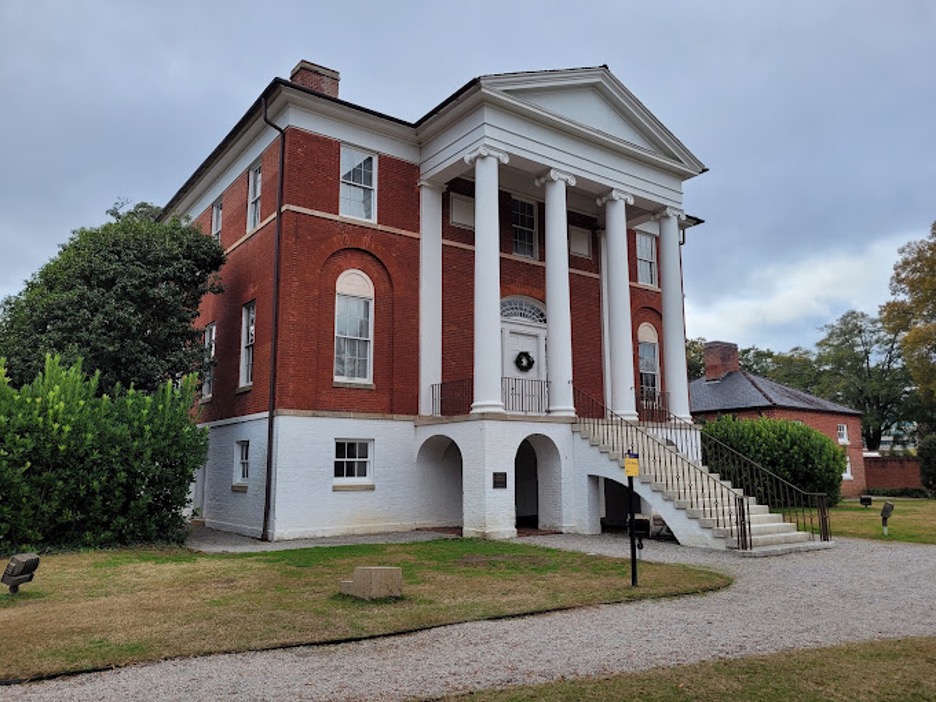

Standing proudly amid Columbia’s historic district, the Robert Mills House is more than just a well-preserved antebellum mansion—it is a national architectural landmark that offers a window into the evolution of American design. Built between 1823 and 1826, the house was designed by Robert Mills, the first professionally trained architect born in the United States and the creative mind behind the Washington Monument in Washington, D.C. His legacy lives on in South Carolina through this neoclassical masterpiece, one of only a few remaining residential buildings attributed to him.
From the moment you approach the Robert Mills House, its balanced proportions, elegant portico, and stately brick façade communicate a vision of order and sophistication. Drawing on the ideals of classical architecture, Mills designed the home with symmetry and rational geometry in mind—an expression of Enlightenment thought as filtered through early American aspirations. The central block of the house is flanked by identical wings, anchored by a grand, columned entrance that reflects the influence of ancient Roman and Greek temples, signaling permanence and civic pride.
Yet this home was not just an architectural exercise. Commissioned by wealthy merchant Ainsley Hall, the building was intended as a private residence but was never occupied by its original owner. After Hall’s death and a tangle of legal and financial complications, the building took on a new life—eventually serving as a seminary and later as a theological school. Each phase of its use added new layers to its story, reflecting the shifting social and educational fabric of Columbia through the 19th and 20th centuries.
Inside, the building’s design emphasizes natural light, cross-ventilation, and spacious rooms—a hallmark of Mills’s functional approach to architecture. He was not only a stylist but a planner and innovator, advocating for public health and fire safety in his designs. The Robert Mills House exemplifies his belief that architecture should serve both beauty and utility—a principle still guiding architects today.
In the 1960s, preservationists recognized the architectural and historical significance of the structure and undertook a meticulous restoration. Today, the house is operated by Historic Columbia and open to the public as a museum, offering tours, exhibitions, and educational programming. Visitors can stroll through the restored grounds, admire the period furnishings, and discover Mills’s lasting impact on American architecture.
At the South Carolina Architectural Foundation, we believe that places like the Robert Mills House are vital to understanding our state’s design heritage. This building tells a story not only of wealth and elegance, but also of innovation, resilience, and the power of visionary thinking. It reminds us that architecture is not only about constructing buildings, but also about constructing identity, culture, and community.
Through Heritage by Design, we celebrate landmarks like the Robert Mills House, where design excellence and historical significance come together to inspire future generations of architects, historians, and engaged citizens alike.
Visit www.scarchitecturalfoundation.org to explore more stories of South Carolina’s built heritage.