

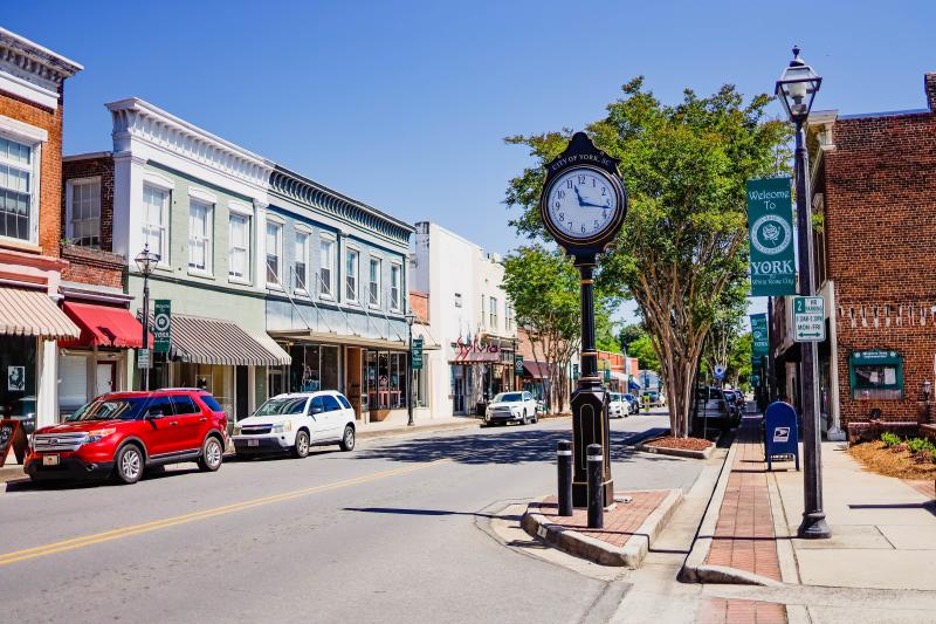
Set amid the gentle rolling landscape of the Piedmont, the city of York offers one of South Carolina’s most architecturally layered and visually coherent historic districts. Known in the 19th century as “The White Rose City,” York flourished as a regional commercial and political center, and its architectural heritage reflects that prominence. Today, its remarkably preserved streetscapes invite visitors to explore more than 200 years of design—from early frontier structures to ornate Victorian homes and stately public buildings that continue to define the city’s civic identity.
At the heart of York’s architectural story is the York County Courthouse, completed in 1914 and designed in the Classical Revival style. Its symmetrical façade, tall Corinthian columns, and imposing central dome convey the ideals of order, dignity, and public service. The courthouse stands as an anchor to York’s historic downtown, where civic life and commercial activity intersect in a cohesive urban fabric marked by brick sidewalks, monumental oak trees, and architectural continuity. Its presence affirms the town’s early role as the seat of regional governance.
Surrounding the courthouse is the York Historic District, one of the most intact collections of 19th-century commercial architecture in the state. Two-story brick storefronts with decorative cornices, arched windows, and cast-iron details line the main streets, illustrating the prosperity York enjoyed during the post-Civil War reconstruction and industrial expansion. Many of these buildings remain in active use, housing shops, cafés, and offices that continue the district’s long tradition of serving as a community gathering place.
Venturing beyond the commercial core, visitors encounter York’s impressive inventory of residential architecture. The town features a rare concentration of Greek Revival, Victorian, Queen Anne, and Colonial Revival homes, each contributing a unique chapter to York’s architectural narrative. Greek Revival properties, with their columned porches and strong geometric proportions, reflect the influence of classical ideals during the antebellum period. By contrast, Victorian and Queen Anne houses showcase a more expressive design vocabulary—turrets, asymmetrical façades, spindlework trim, and stained-glass windows—revealing the craftsmanship and decorative tastes that defined the late 19th century.
York also boasts elegant Colonial Revival residences from the early 20th century, marked by symmetrical façades, gabled roofs, and multipane windows. These homes represent a return to American historical styles during a period of renewed national pride, blending modern comforts with timeless architectural motifs. Together, these varied neighborhoods present a cohesive and walkable environment that reflects the town’s growth across multiple generations.
Complementing the civic and residential landscape are York’s historic churches, including First Presbyterian Church and St. Paul United Methodist Church, both of which feature traditional Gothic and Romanesque elements. Their pointed arches, stained-glass windows, and soaring steeples reflect the central role of religious life in shaping community architecture.
York’s remarkable preservation is not an accident—it is the result of decades of community stewardship, historic district protections, and a shared commitment to honoring local heritage. As the city continues to grow, its architectural identity remains firmly rooted in its past, offering a model for how small towns can preserve a sense of place while embracing future opportunities.
Through the Heritage by Design series, the South Carolina Architectural Foundation celebrates communities like York, where architecture provides a lens through which we understand history, identity, and the enduring value of thoughtful design.